

Translated by AI model deepseek-flash.
Source Language: Simplified Chinese, Target Language: english, Translation Time: 2026-10-27 10:20
.AI translation is for reference only. Accuracy is not guaranteed, please refer to the original text.
This article was written with AI assistanceThis article is purely AI-written, human involvement: 0%
At 3
this afternoon, I made a decision: build my own blog backend.By 10
that night, it was already usable.A little over 5 hours, 17 commits, nearly 700 million Token.
This idea had actually been sitting in my mind for a long time.
Back in 2024, in order to edit my blog online, I struggled with Decap CMS, configuring it step by step from Netlify to Git Gateway. After setting it up, I even wrote a step-by-step tutorial.
But honestly, after that thing was set up, I could count the number of times I used it on one hand. The interface wasn't great, it was even harder to use on mobile, and if I wanted to add a field, I had to go back and change the config, then redeploy. Later I moved the blog from Hexo to Astro, stopped using Netlify Identity, and Decap just sat there.
So over the years, my way of updating the blog stayed the same old routine: turn on the computer, open the editor, make changes, push. When I was out, it basically meant no updates.
I kept thinking about when I'd have one that felt comfortable to use.
Today I finally got started.
I explained my idea and requirements to AI, and even seriously wrote a plan.md—it's still in the repo now, and it's written quite convincingly.
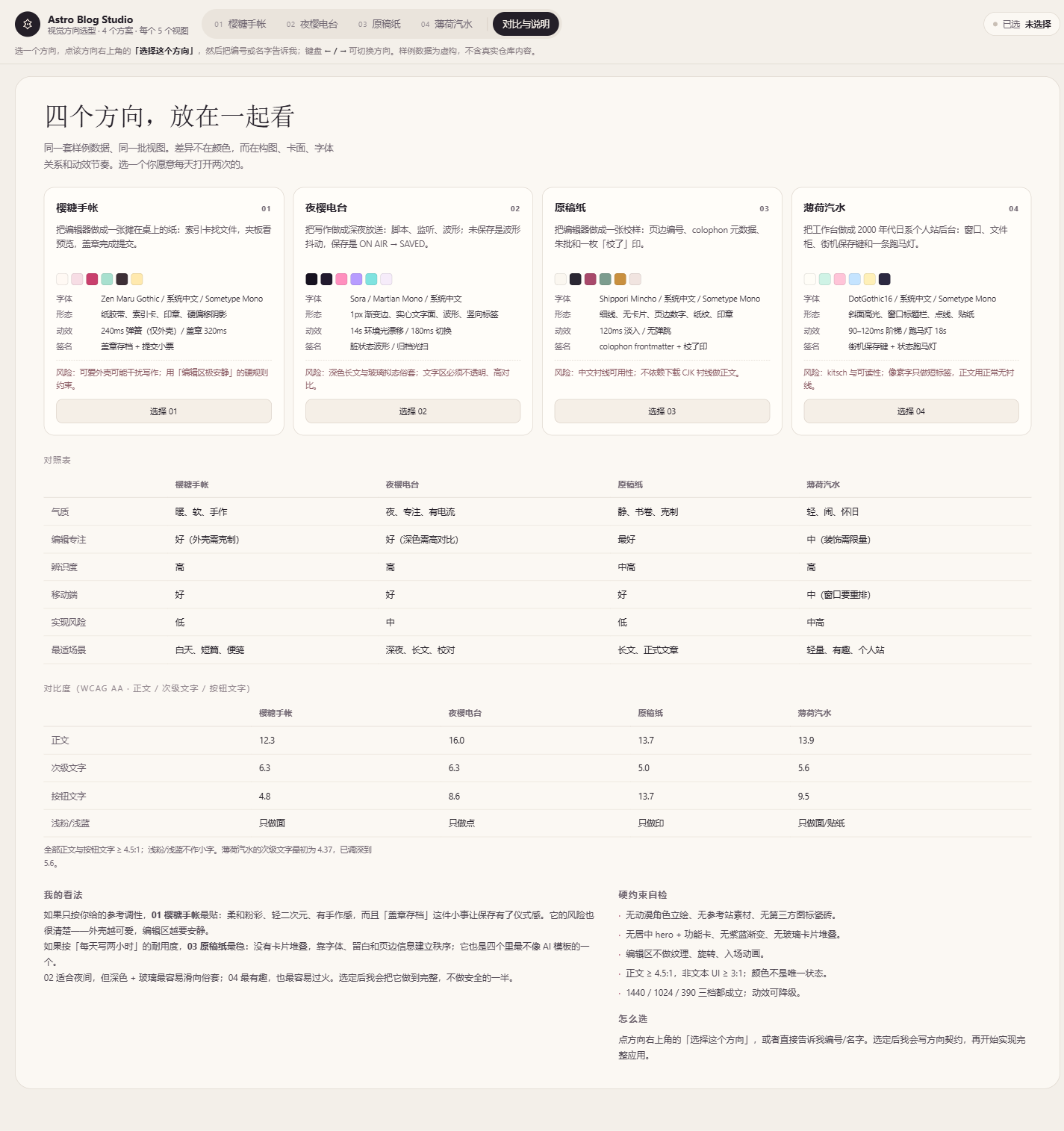
Then I first had it produce four visual directions. I immediately took a liking to No. 01, "Sakura Sugar Journal": files are index cards, editing is paper, committing is stamping.
Then came an afternoon and an evening.
Almost all the code was written by AI. I came up with the requirements, I picked the visual direction, and I reviewed every interface screenshot by screenshot; but how exactly to implement it, I basically didn't touch. My job was more like: make requests, click buttons, and then say, "This doesn't look good, change it again."
There was quite a bit of fiddling in between too. For example, dark mode wasn't decided on a whim—I first made a separate comparison page, and only then settled on warm ink paper; and PWA—the code was clearly written, but the Service Worker just wouldn't show up in pnpm dev. It took ages to figure out that it doesn't register in the dev environment at all, and you have to build and then preview to verify it.
Finally I added "local backup." The thing I fear most when writing is accidentally refreshing, and now the bottom bar shows "Backed up locally 22
"; after a refresh, unsaved content can still be recovered, which makes me feel much more at ease.By 10
that night, after the last commit, I opened the webpage, clicked into an article, changed the title, and clicked "Stamp and Save."Then I went to GitHub and saw one more commit.
That moment felt pretty good.
I went ahead and published dist/ to sakura.ksable.top; now, in the classroom, in the dorm, or on the road, I can open the webpage and write.
Back to the point—why is it more convenient than the old Decap:
- No environment setup needed. It's just a purely static web page, now deployed at sakura.ksable.top. I have the address bookmarked in my phone browser, so it's as handy as scrolling through posts.
- The interface is much nicer. It's not one of those "good enough to work" CMS backends—it's a journal page; and at night there's dark mode.
- It's finally usable on mobile. The drawer on the left is the file tree, the main text is below, and the stamp button is pinned to the bottom of the paper.
- Saving is committing. No need to open a terminal or wait for a local build. Make a change, click once, and there's one more commit on GitHub.
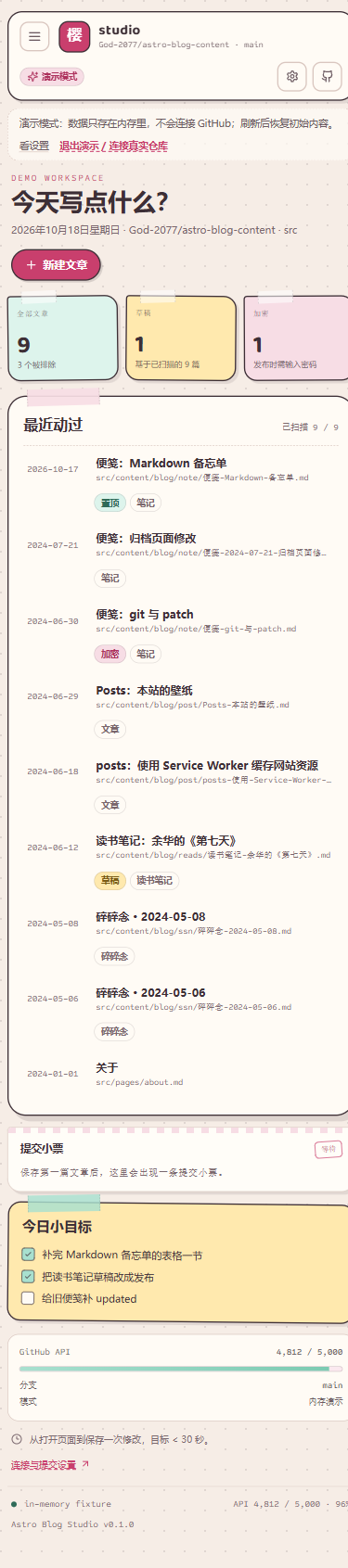
From now on, when I want to post random thoughts, I don't have to wait until I get home or until I have time; whatever comes to mind on the road, I can pull out my phone and edit a couple of lines.
But honestly, after finishing this, what struck me most wasn't the interface—it was AI.
When I used to make things, the biggest bottleneck was "I can imagine it, but I can't build it": I'd have a rough picture in my head, but I didn't know CSS or React, so I'd dig through docs for ages, write for two days, and end up with a mishmash that looked nothing like it.
Now it's different. As long as I explain clearly what I want, AI can do the rest—and do it better than I could.
But after spending this afternoon on it, I also realized: AI can write the code for me, but it can't make decisions for me.
What kind of interface counts as good-looking, which interaction feels smooth, where to cut corners, and where something must stay—no one can think through these for me. Today's 16 commits—I gave the nod to every single one myself.
So after the barrier to entry was lowered, what actually became difficult was something else: what do you actually want?
By the time I finished writing this, it was almost midnight. I have class tomorrow, so I'm going to sleep first.
I should be able to update the blog diligently from now on...Let me plant a flag first—don't let next month be another whole month without updates.
Live site: https://sakura.ksable.top/
Project address: God-2077/astro-blog-studio
If you enjoyed this, leave a comment~